Published March 23, 2020 by Katherine Sullivan.
As the COVID-19 outbreak becomes a rapidly growing crisis in the U.S. and beyond, folks are arming themselves with necessities, including knowledge. The outbreak has caused us all to become more familiar with terms like “novel coronavirus,” “self-quarantine,” and—here’s a new one—“wet market.”
What is a wet market?
Experts believe that the novel coronavirus originated at the Huanan Seafood Market, a wet market in Wuhan, China. A wet market (sometimes referred to as a “wildlife market”) sells live and dead animals—including fish, birds, badgers, bats, pangolins (scaly anteaters), and turtles—for human consumption.
The term is pretty on point: These markets are wet. Water splashes over the sides of open tubs filled with live sea animals who will inevitably be killed, countertops and floors are streaked red with the insides of gutted fish and slaughtered animals’ blood, and turtles crawl over each other before their shells are cut off while they’re still alive:
It’s no wonder that a deadly virus flourished in such an environment. These markets—crammed full of stressed, likely terrified animals—are breeding grounds for diseases like COVID-19. But what about the live-animal markets that exist here in the U.S.—or any animal agriculture operation, really? What’s the difference between these chickens at a wet market in Taiwan and the ones at the more than 80 live-animal markets and slaughterhouses operating in New York City? How are the restaurants in Los Angeles that mutilate and serve live animals to customers any better than wet markets in Asia? Zoonotic viruses don’t originate exclusively in wet markets. The types of animals most commonly connected to viral outbreaks in humans are chickens and pigs. And the U.S. is home to countless farms where chickens are crammed together in small cages and pigs are packed in feces-ridden sheds as well as slaughterhouses where chickens and pigs are killed on floors soaked with blood, urine, and other bodily fluids. So while current events have many calling for an end to wet markets and the wildlife trade in Asia, it’s simply not enough.
To prevent pandemics like coronavirus, we must end the demand for animal flesh entirely.
It’s been widely speculated that bats (some of whom build friendships in ways similar to humans) sold for soup could be COVID-19’s origin point. But since previous influenza viruses have originated in chickens and pigs, we can’t blame bats or other wild animals for these outbreaks.
ZOONOTIC VIRUSES AREN’T A WET MARKET OR WILDLIFE-TRADE PROBLEM—THEY’RE A HUMAN PROBLEM. HUMANS’ ACTIONS TOWARD OTHER ANIMALS CREATED COVID-19, AND IT’S UP TO US TO SHAPE UP.
Deadly diseases like COVID-19 will keep breaking out until the world stops eating animals. If we were all vegan, COVID-19—along with SARS and MERS—likely wouldn’t exist. Plus, animals deserve better than this:
Just as we don’t want to become infected with or die of COVID-19, animals don’t want to suffer or be killed for food. Pigs, for example, just want to be left in peace to nurse their young, protect their friends, and relax in the sun (much like humans).
BIRD FLU, CORONAVIRUS, HEART DISEASE, SALMONELLA … WHEN WILL PEOPLE REALIZE THAT EATING ANIMALS KILLS IN SO MANY WAYS?
Yes, wet markets should be banned. But please, ban meat, eggs, and dairy from your plate—before the next deadly zoonotic disease hits.
Thursday, March 26, 2020

Wednesday, March 18, 2020
Tapah Fish
Hii..did you know Tapah Fish?

The physical feature of Tapah fish is similar to Keli fish, the main difference between these two is the dorsal fin. The dorsal fin of Tapah fish is small, while the dorsal fin of Keli fish is huge and long.

Tapah fish is categorised as warm water fish. It feeds on animal baits. The female Tapah fish is able to grow quite rapidly, and its large body size is one of the features of female Tapah fish, which makes it very valuable in fish farming for its breeding value. Meanwhile, the male Tapah fish that is smaller in size is not valuable in fish farming.

The flesh of Tapah fish is highly appreciated due to its tender textures and scrumptiousness. Tapah fish likes to stay under muddy surface, feed on benthic organisms and planktons, and sometimes, it would feed on fragments of water plants
Tuesday, December 17, 2013
Kelah Sanctuary, "TAGAL" Sungai Moroli, Kampung Luanti Baru, Ranau
Hii welcome to kelah sanctuary to have foot massage reflexology here...


Location are at Sungai Moroli, Kampung Luanti Baru, Ranau, Sabah, Malaysia.


Wednesday, November 20, 2013
The Freak From The Deep: Long-nosed fish that lives 3,000 ft below the ocean!!
Hii everybody..
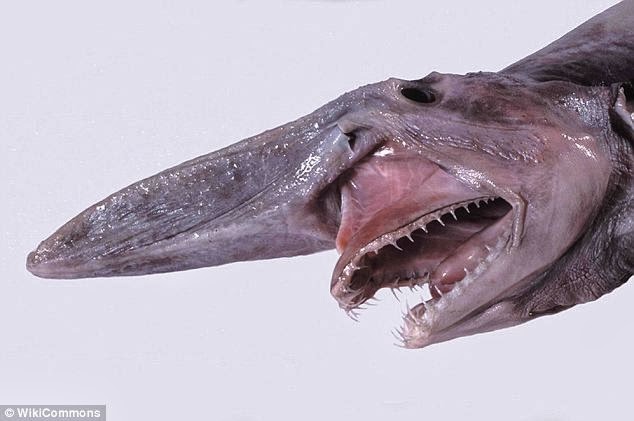
An extremely weird looking fish (o.,.o) was snagged recently in the frigid artic waters off northern Canada and after some confused speculation about what it even is, researchers have identified it as the super rare long-nosed chimaera fish.
The spooky, deep sea fish has a long nose, menacing mouth, and a venomous spine atop its gelatinous grey body and was caught near the northernmost province of Nunavut in Davis Straight.
Researchers, who at first believed the odd fish was the similarly freakish goblin shark, say the long-nosed chimaera likely makes its home at depths not often visited by humans.


Friday, October 22, 2010
American Shad - Heritage,Commercial,Valuable Fish
Recent captures of hatchery-reared, American shad juveniles indicate the species is being restored into the lower reaches of North Carolina’s Roanoke River. The American shad, a species related to the herring and native to the Atlantic coast from the St. Lawrence River to the tip of Florida, has been commercially valuable for its meat and roe since colonial times.

 In connection with a U.S. Fish and Wildlife Service partnership program to help restore depleted populations of American shad along the Atlantic coast, the Service’s Edenton National Fish Hatchery, in Edenton, North Carolina, and North Carolina’s Watha State Fish Hatchery, reared and released approximately two million American shad fry into the Roanoke River last spring.
“American shad is part of our Nation’s heritage and is still important commercially and recreationally although its population has been in decline for several decades,”said Ronnie Smith, fisheries biologist with the Service’s Edenton National Fish Hatchery.
“The shad’s restoration will benefit Atlantic coastal communities and the life cycles of other fish species.”
“We are very satisfied to discover that our cooperative production and stocking efforts are contributing to the restoration effort this early in the Roanoke River American shad project,” said Jeff Evans, hatchery supervisor with the North Carolina Wildlife Resources Commission’s Watha Fish Hatchery. “We plan on continuing to improve our production and stocking proficiency of American shad fry to provide an optimal contribution to the restoration project.”
Species of shad and river herring once supported important commercial and recreational fisheries along the Atlantic coast, which included North Carolina’s Albemarle Sound fishery that in the mid-1840s had 15 large haul seine operations, employing approximately 1,000 workers. The major tributaries to the Albemarle Sound are the Roanoke River and Chowan River.
The Albemarle Sound’s most valuable fishery, American shad, was shipped to markets in Baltimore, Maryland, and marketed in Richmond, Petersburg, and Norfolk, Virginia. The shad’s oily flesh permitted it to be preserved with salt and hence, shipped without ice or refrigeration. The average landings of American shad and river herring from 1890 to 1970 were almost 11.9 million pounds per year.
During the past 75 years, however, Atlantic coastal American shad populations have steadily declined, and the catch totaled only 1.5 million pounds in 1992 and 1993. This long decline has been due to over fishing and habitat degradation in spawning areas. Historically, American shad spawned in virtually every accessible river and tributary along the coast, but dams and other impediments together with degradation of water quality have severely depleted suitable American shad spawning habitat.
The hatchery-produced shad were caught during a sampling of outward migrating juveniles in the lower Roanoke River by the Inland Fisheries Division of the North Carolina Wildlife Resources Commission. The sampling began in August and was conducted weekly through November 2004 using electrofishing. Of the 228 juvenile American shad collected, state biologists reported that 10 had been marked with the antibiotic, oxytetracycline indicating that they were hatchery reared. Prior to their initial release from the hatchery, the fry were immersed in water containing a small amount of oxytetracycline, which leaves a telltale stain on the fish’s ear bone. In 2003, the first year in which American shad were stocked above John H. Kerr
Reservoir, outward migrating juveniles marked with oxytetracycline were also captured.
As both Edenton and Watha hatchery staffs continue to become more proficient in hormone-induced tank spawning of American shad, the emerging picture is that fry stocking will continue to increase shad populations in the future.
The U.S. Fish and Wildlife Service is the principal federal agency responsible for conserving, protecting and enhancing fish, wildlife and plants and their habitats for the continuing benefit of the American people. The Service manages the 95-million- acre National Wildlife Refuge System, which encompasses 545 national wildlife refuges, thousands of small wetlands and other special management areas. It also operates 69 national fish hatcheries, 64 fishery resources offices, and 81 ecological services field stations. The agency enforces Federal wildlife laws, administers the Endangered Species Act, manages migratory bird populations, restores nationally significant fisheries, conserves and restores wildlife habitat such as wetlands, and helps foreign and Native American Tribal governments with their conservation efforts. It also oversees the Federal Assistance program, which distributes hundreds of millions of dollars in excise taxes on fishing and hunting equipment to State fish and wildlife agencies.


Physical Characteristics
The American shad, like the alewife (gaspereau), is a member of the herring family with the following characteristics:
The American shad, like the alewife (gaspereau), is a member of the herring family with the following characteristics:
- slender and silvery-coloured with a blue-green metallic hue on the back;
- has a black spot, similar to the alewife, located on the side, just behind the head - on the shad, this spot is followed by several smaller dark spots;
- the eye has an obvious eyelid;
- a row of scales known as scutes form a sharp "sawbelly" edge along the midline of the belly;
- there is no lateral line.
- American shad can grow to 76 cm (30 in) and weigh 6.8 kg (15 lb). However, adults found in Canadian rivers are usually 45-50 cm (18-20 in) long and weigh from 1.4-2.7 kg (3-6 lb).
- American shad can migrate up to 3,000 km in one season!
- The flesh of the American shad is very tasty. Did you know the scientific name for shad comes from the Saxon word "allis", an old name for the European shad, and the Latin sapidissima meaning "most delicious"?
- The French common name for this fish is alose savoureuse or "savoury shad".
- The world angling record for American shad weighed 5.1 kg (11.2 lb) and was caught in the Connecticut River, Massachusetts, in 1986.
- Scientific studies show that shad from all eastern U.S. rivers spend some time in the Bay of Fundy.
Thursday, August 26, 2010
New Species Of Fish Discovered - Anglefish

A fish that would rather crawl into crevices than swim, and that may be able to see in the same way that humans do, could represent an entirely unknown family of fishes, says a University of Washington fish expert.The fish, sighted in Indonesian waters off Ambon Island, has tan- and peach-colored zebra-striping, and rippling folds of skin that obscure its fins, making it look like a glass sculpture that Dale Chihuly might have dreamed up. But far from being hard and brittle like glass, the bodies of these fist-sized fish are soft and pliable enough to slip and slide into narrow crevices of coral reefs. It's probably part of the reason that they've typically gone unnoticed - until now.
The individuals are undoubtedly anglerfishes, says Ted Pietsch, a UW professor of aquatic and fishery sciences who has published 150 scholarly articles and several books on anglerfishes and is the world's leading authority on them. In the last 50 years scientists have described only five new families of fishes and none of them were even remotely related to anglerfishes, Pietsch says.
Husband and wife Buck and Fitrie Randolph, with dive guide Toby Fadirsyair, found and photographed an individual Jan. 28 in Ambon harbor. A second adult has since been seen and two more -- small, and obviously juveniles -- were spotted March 26, off Ambon. One of the adults laid a mass of eggs, just spotted Tuesday.
The Randolphs are part-owners of Maluku Divers, a land-based dive facility in Ambon City. Toby Fadirsyair, who works for Maluku Divers, said he may have seen something similar 10 or 15 years ago but the coloring was different.
Reference books were consulted but nothing similar to the fish photographed in January was found. Seeking international fish experts eventually led them to Pietsch.
A Rare Fish Find
"As soon as I saw the photo I knew it had to be an anglerfish because of the leglike pectoral fins on its sides," Pietsch says. "Only anglerfishes have crooked, leglike structures that they use to walk or crawl along the seafloor or other surfaces."
Anglerfishes -- also called by names like frogfishes and toadfishes -- are found the world over and typically have lures growing from their foreheads that they wave or cause to wiggle in order to attract prey. Get too close to the lure and you're lunch.
The newly found individuals have no lures so they seek their prey differently, burrowing themselves into crevices and cracks of coral reefs in search of food.
"Several times I saw these fish work themselves through an opening that seemed much smaller than the fish, sometimes taking a minute or more to get all the way through," says David Hall, an underwater natural history photographer who was able to dive with Maluku Divers and take additional photos of the new find. "They must have pretty tough skin to keep from being scraped and cut, but there is no evidence of superficial injury or scars in my photographs."
With its unusual flattened face, the fish's eyes appear to be directed forward, something Pietsch says he's never seen in 40 years as an icthyologist, a scientist who studies the structure, classification and habits of fishes. Most fishes have eyes on either side of their head so that each eye sees something different. Only very few fishes have eyes whose radius of vision overlaps in front, providing binocular vision, a special attribute well developed in humans that provides the ability to accurately judge distance.
Randolph, a longtime diver, says the similar color pattern of the two adults surprises him because he typically sees variations in skin color between members of the same anglerfish species and has even seen individual anglerfish that change colors depending on the surroundings.
Whether the new fish represent a new family will entail DNA testing and a close examination of a specimen, says Pietsch, whose anglerfish work is currently funded by the National Science Foundation. Scientists have already described 18 different families of anglerfishes and this is probably a 19th, Pietsch says. Families are large groupings, for example, all dog species belong to the larger family that includes wolves, coyotes and, even, hyenas.
When only a single fish had been sighted, Randolph and Andy Shorten, co-owner of Maluku Divers, kept the find quiet to protect the animal. With more individuals being found, and having a better idea of where to look to find others, the two became comfortable enough to post images on the firm's Web site.
"Seeking out these fish is probably going to be like the Holy Grail of divers for a while," Shorten says. Indeed just do a Google search for "new frogfish Ambon" on the Internet and up pops a lot of dive sites carrying news of the find.
"I don't think it will turn out that there are a lot of these animals but all that scrutiny will help us find out for sure," Shorten says.
For example, 35 years ago nobody realized pygmy seahorses existed but once they were discovered and people understood where to look for them, they turned out to be widespread throughout the ocean.
The fish were seen in 15 feet of water. It's possible the fish could be found at other locations, Pietsch says. All other anglerfish families have ranges broader than a single island group and ocean conditions like those at Ambon are found at various places across Indo-Australian waters.
Habitats in Indo-Australian Waters
The fish were seen in 15 feet of water off Ambon Island. It's possible the fish could be found at other locations, Pietsch says. All other anglerfish families have ranges broader than a single island group and ocean conditions like those at Ambon are found at various places across Indo-Australian waters.
Andy Shorten said that although many divers will treat looking for the new anglerfish as a search for the Holy Grail, they don’t think that there are large numbers of the species. However, the more people looking, the more likely it is that more specimens will be found.
“For example, 35 years ago nobody realized pygmy seahorses existed but once they were discovered and people understood where to look for them, they turned out to be widespread throughout the ocean."
Sunday, March 28, 2010
Malaysian Fresh Water Fish


Sebarau
(Hampala macrolepidota)
This is probably our liveliest sportfish! Weight for weight, I personally rank it as the hardest fighting freshwater fish in Malaysia! From the sudden thumping strike till the last seconds before it is landed, the sebarau just never gives up fighting the angler!
In comparing it to the fish of the temperate climates, I'd say its traits are similar to the rainbow trout. The sebarau readily takes artificial lures with its aggressive character. The habitat too is very similar.
It can be found in the larger streams, rivers, old mining ponds with streams running in, lakes and dams. They will lurk around structure in the flowing water. Using the eddies of fallen trees, branches and rocks to wait for passing prey. In still waters, the smaller sebarau can be found in and around shallow weedbeds. However the bigger sebarau will take up residence in deep waters. Areas with submerged tree trunks or fallen logs will produce sizable sebarau that sit in these deep waters.
Sebarau up to a kilo give great sport on light casting tackle. Bigger sebarau require heavier tackle especially in snaggy areas. A sebarau over 2 kilos would be regarded as a rewarding catch. Sebarau as big as 5-7 kilos have been caught.
Artificial lures like spoons, soft plastics, spinners, spinnerbaits and minnow profile plugs readily account for most of the sebarau caught. Flies like poppers, clouser minnow and deceivers will work for the fly fisherman
Saturday, March 27, 2010
Silver Arowana
Hye everybody..


The Silver Arowana comes from the Amazon River in South America. They are very beautiful and a fascinating fish to watch. However, because of their huge adult size of 35 - 40 inches (89 - 102 cm) they are not recommended for the beginning aquarist. Actually, this is one of those fish that are probably best kept in the wild or in huge public aquariums. The Arowana requires at least a 200 gallon (750 liters) tank to adequately keep them. You also need an excellent aquarium filter such as an external canister filter. Arowanas are also excellent jumpers so you will need a good, tight fitting hood with no escape holes. In the wild, the Silver Arowana can jump out of the water at insects and small animals on overhanging branches.
Because of their potential adult size, there are not many compatible tank mates that quickly come to mind but you may be able to keep an Arowana with a larger Common Pleco.
This fish is definitely one fish species that is best left to the experts and public aquariums.
Picture


Saturday, December 12, 2009
Trout Fishing Almost Heaven - 09
Hye everybody..
 Trout for dinner
Toss this offering out upstream and drift it through deep runs, pools and eddies. Rocks and log-jams that offer shelter from the flow for pot-gutted hatchery fish suddenly faced with the rigors of a wild stream are also worth casting to. A sharp tap-tapping should telegraph up the rod if you're fishing good water. Strike quickly to drive the barb home and there may be trout for dinner.
Artificials such as Panther Martins and Flatfish will also take stocked trout when cast upstream and across and retrieved down through the current. Small marabou jigs crawled along the bottom can fool whoppers at times when the flashy spinners don't produce.
The fly fisherman can take his share of trout at this time as well, since many holdover fish from earlier plantings will be accustomed to feeding on natural insects. Some of the newly stocked fish also learn quickly that a mayfly or beetle tastes every bit as good as the brown pellets they were fed throughout their lives in the concrete troughs of a hatchery.
Most West Virginia streams are on the acidic side and lack heavy aquatic insect hatches. This makes the fish particularly fond of land insects such as beetles, ants, grasshoppers and crickets. Toss imitations of these bugs along the banks with a light splat or softly to any rises you see in midstream. If no takers show, tie on a weighted nymph and float it "dead drift" through the fishy-looking runs and deep pools.
And if all else fails, pick up the scattergun and go chase a grouse or woodcock through the bright autumn woods. That's sure to take the sting out of a poor trout fishing day.
See u all guys in next post..
Looking for an excuse to visit West Virginia in the fall? Here are three good ones: Trout fishing, hunting and viewing fall's foliage.
If ever there was a time to head for the Mountain State, it's in October to do some trout fishing. This is also the time that several small game seasons, plus turkey and archery deer hunting are all open. Fall foliage is nearing its sunburst peak. And 70,000 trout are being stocked during the second and third weeks of October -- a time when the state truly lives up to its "wild, wonderful" slogan.
Combine trout fishing with hunting for fun
Saturday morning, grouse, squirrel, raccoon and woodcock seasons open; duck and dove seasons continue; turkeys become legal game; and the bow-and-arrow deer season begins. Prospects for hunting virtually all of these game animals should be excellent.
The state's deer herd is growing, a record spring gobbler harvest was posted this year, and grouse are in the midst of a modest upswing. West Virginia has always been a top woodcock state, and huge flights of these long-beaked birds drop into the Canaan Valley, near Davis during the fall.
And while the brightly painted leaves clinging to deciduous trees are a hindrance in viewing game, they add an esthetic value that few sportsmen would want to forego. The foliage usually reaches its peak of color intensity during the second and third week of October in the Eastern Panhandle, where most Washington-based visitors will spend their time.
While most cabins and lodge rooms at state parks and forests have been reserved well in advance, a few are still available. Phone 800/642-9058 toll-free in Charlestown for information on what's left.
Streams stocked with trout
If the foliage and opening of hunting seasons weren't enough to draw one to West Virginia, 30 of the state's best trout streams will receive some 70,000 new trout. While it's frowned upon by purists, stocking is often necessary in streams where the natural spawning isn't enough to establish a viable trout fishery. Such, sadly, is the case in manyWest Virginia streams where the waters are cold and clear enough to hold trout, but reproduction is poor.
If there must be stocking of adult trout, West Virginia does a good job of it, often raising fish to a husky 11 to 14 inches before releasing them. The trout are stocked on a weekly basis during spring in some of the more popular creeks. The state also has no closed-season and opening-day fiasco concentrating droves of anglers in a carnival-like atmosphere along the banks.
During October, the state's yearly effort concludes with a bang. Not only are 70,000 trout being placed in the streams, 5,000 of them are brood fish ranging from 15 to 22 inches.
All of the waters listed under the "F" code in the current fishing regulations (except the Summersville Lake tail waters) will receive fish. Some of the more popular streams within a day's driving distance of Washington include Edward's Run and Pond in Hampshire County; Opequon Creek in Berkeley and Jefferson counties; and Rock Cliff Lake, Lost River and Trout Pond in Hardy County. Slightly farther (three to six hours) are Shaver's Fork, Knapps Creek, Buffalo Fork Lake, Beaver Creek and the Cranberry River in Pocahontas County. The Buckhanon and Blackwater rivers in Tucker County and North Fork of the South Branch in Pendleton and Grant counties are also good streams. The locations of these waters are shown in theWest Virginia Stream Map, available from the Department of Natural Resources, 1800 Washington Street East, Charleston 25305.
With this immense quantity of naive hatchery trout in the streams, bait is the most potent offering. Salmon eggs, minnows, redworms and nightcrawlers all will fool their share of trout, but they'll fool a lot more when fished in a natural fashion, rather than being plunked down with a heavy weight so they hang unrealistically on the bottom.
A light spinning outfit and four-to six-pound line will handle all trout, even those big breeder fish over 20 inches, if the reel's drag works smoothly. For holding the bait and snatching the fish, use gold hooks in sizes 6 to 10. Depending on the depth of water and rate of current, attach one to three very small split shot on the line a foot above the bait.
A light spinning outfit and four-to six-pound line will handle all trout, even those big breeder fish over 20 inches, if the reel's drag works smoothly. For holding the bait and snatching the fish, use gold hooks in sizes 6 to 10. Depending on the depth of water and rate of current, attach one to three very small split shot on the line a foot above the bait.
Toss this offering out upstream and drift it through deep runs, pools and eddies. Rocks and log-jams that offer shelter from the flow for pot-gutted hatchery fish suddenly faced with the rigors of a wild stream are also worth casting to. A sharp tap-tapping should telegraph up the rod if you're fishing good water. Strike quickly to drive the barb home and there may be trout for dinner.
Artificials such as Panther Martins and Flatfish will also take stocked trout when cast upstream and across and retrieved down through the current. Small marabou jigs crawled along the bottom can fool whoppers at times when the flashy spinners don't produce.
The fly fisherman can take his share of trout at this time as well, since many holdover fish from earlier plantings will be accustomed to feeding on natural insects. Some of the newly stocked fish also learn quickly that a mayfly or beetle tastes every bit as good as the brown pellets they were fed throughout their lives in the concrete troughs of a hatchery.
Most West Virginia streams are on the acidic side and lack heavy aquatic insect hatches. This makes the fish particularly fond of land insects such as beetles, ants, grasshoppers and crickets. Toss imitations of these bugs along the banks with a light splat or softly to any rises you see in midstream. If no takers show, tie on a weighted nymph and float it "dead drift" through the fishy-looking runs and deep pools.
And if all else fails, pick up the scattergun and go chase a grouse or woodcock through the bright autumn woods. That's sure to take the sting out of a poor trout fishing day.
See u all guys in next post..
Friday, July 31, 2009
Fish Conservation
The Freshwater Fish Keystone focuses on species and habitats species that occur in the U.S. or its territories and that have been identified as high priorities for the nation. Freshwater fish (anadromous and catadromous) and associated aquatic life such as mussels, crayfish, and other invertebrates are included in this Keystone. Our goal in the Freshwater Fish Keystone is to find the best conservation investments, fund the best solutions, and deliver measurable results for fish conservation. Under this mission statement we have selected Initiatives that focus on making a measurable impact on the status of specific species and their habitats. Individual Initiatives are listed to the right and are focused under the three themes below that we believe are critical for conserving freshwater fish, aquatic organisms, and their habitats.
Water Flows
Climate Change and Adaptation
Imperiled Fish: Apache Trout and Upper Klamath Basin
Goldfish and Snails Is it Worth the Risk?
Hello readers, happy weekend..
Over the past few days, there has been much discussion over the sustainability of keeping goldfish and various species of snails together in an aquarium setting. Though it is certainly a combination that can work, there are many reasons why caution is necessary. The purpose of this article is not to dissuade one from trying to attempt such a combination, but to explore the risks present to the health and well being of both animals when such a mix is being considered.
Very often, when this topic is discussed, it is framed only in terms of the danger snails face in the presence of goldfish. Generally ignored however, is the fact that goldfish also face debilitating, even mortal injury at the hands of their snail tankmates. A quick google search with the words goldfish, stuck, and mouth, will return all sorts of hits, involving everything from pebbles to cory cats, even otocinclus. The simple fact is, if it fits in your goldfish’s mouth, there is a very real possibility that it will at some point, end up in there. The problems occur when something is small enough to get in, but just big enough not to be easily extricated. Often in these cases, if the fish is unable to free the object itself, keeper intervention becomes necessary. Pulling the object out via tweezers is usually the only solution, and items can sometimes cause even greater damage on the way out. It is not uncommon for fish who have been through such traumas to die, even after the blockages have been removed. Thus, for the safety of your goldfish, they should only be kept with snails small and smooth enough not to pose a threat (read: no MTS), or entirely too large to feasibly fit into their mouths. Additionally, one must be just as cognizant of spreading disease when adding new snails to a system as with new fish. The same quarantine rules must apply. Though snails bred and raised by responsible hobbyists are safer than pond raised snails, one must always be cautious when adding new stock.
So one can see that keeping goldfish safe in the company of snails is a relatively easy task. Unfortunately, keeping snails safe in the company of goldfish can be significantly more complicated. The danger that goldfish present to snails is not one borne of a desire to eat them, but rather a desire to find out if they are indeed edible. Goldfish explore their worlds through their mouths, and new or unfamiliar things are often nipped at. This does not equate to aggression on the goldfish’s part, but it is difficult to picture a snail rationalizing why it is being bitten. Beyond that, and perhaps more importantly, is the issue of ensuring that both parties get enough to eat. Goldfish are notoriously greedy, powerful, and efficient feeders. This might equate to an abundance of food for obligate algae eaters, but for the pomacea type snails, who have pretty serious metabolic needs, this can be a double edged sword. Beyond being unable to compete effectively against the goldfish for the same food resources, their stress reactions to rough treatment can also come into play. “Stress in general, especially for bridgesii snails really limits their quality of life. I would be concerned the boisterous and energetic qualities of goldfish as well as their tendency to explore with their mouths would make cohabitating a more beneficial experience for the goldfish than the snail. I don't even really recommend keeping snails with boisterous tankmates like barbs, danios, etc, because the snails tend to be less outgoing (MsJinkzd).” Most importantly, stressed snails are also much less likely to be able/willing to feed properly, even further exacerbating concerns over getting them the proper nutrition they require.
As you can see, the issues involved in keeping goldfish and snails together are a bit more complicated than they might seem to the novice. One cannot simply throw a few snails in with a few goldfish, wait a couple weeks, and proclaim that all is well and will always be as such. “But I watch my tank all the time, and have never seen my goldies harass their snaily friends!” It’s important to remember that most of the time we are near our goldfish tanks, their attention is quite fixated on us, and the possibility of an impending meal. Just because one does not witness goldfish on snail harassment, does not mean it does not happen. A fish that has just been fed may have little to no interest in his snail tankmates, but the same fish after a day or two of fasting might have a very different reaction to a brig’s waving antennae. Though it is quite unlikely that a goldfish would simply predate on a snail beyond a given size, the possibility for harassment is very much there, and considering the quality of life issues that snails face when housed with goldfish, as well as the danger issues goldfish face when housed with snails, one really has to ask themselves: Is it worth the risk?
Friday, January 16, 2009

Saturday, December 20, 2008


There is no disputing that the fish is a large one, and, with a mouthful of sharp teeth, a ferocious looking one at that! However, the fish is not a piranha. In fact it is a Giant Tigerfish (aka Goliath Tigerfish, African Tigerfish). Tigerfish and piranha belong to the same family (Characidae) but are entirely different species. Piranha can grow to a maximum length of 60 cm, but most are smaller.
The natural habitat of the Giant Tigerfish is the rivers and streams of Africa. Although the fish shown in the photographs is a large example of its species, Giant Tigerfish are known to grow to enormous sizes and are considered by fishermen around the world as one of the top game fish.
The exact location where the shots were taken and the identity of the fishermen is currently unclear.
Piranha
 Moves such as James Bond made in the 1970s and 1980s have made the piranha a worldwide phenomenon. But, did you know that there are 20 different species of the piranha in the Amazon and nearly all of them are vegetarian? In fact, the only species of piranha that can strip flesh of an animal in double quick time are the red-bellied piranha.
Friday, October 10, 2008
Selecting the Best Trout Fly
"What to cast, what to cast?" is the No. 1 question you'll face when you pursue trout with a flyrod.
| |  |
Trout and all fish select-or reject-a fly based on the three basic "S's": size, shape and color spectrum. The best fly size matches the local food sources and shapes as accurately as possible. For the color spectrum, your fly should look like other naturally occurring food sources as it reflects natural light waves in the water-or while sitting on top of the water. The fish will let you know when you have made a good fly selection and perfect presentation.
Know Your Water
Know Your Foods |


Saturday, October 4, 2008
Asian Snakehead Fish-made it!!
The Asian snakehead fish is actually not a single species; a lot of different species in the family Channidae are commonly referred to as Asian snakeheads. They are also known as Frankenfish and Channa fish. Snakeheads are not only native to South East Asia; many species have originated on the African continent. A few years back, the Asian snakehead fish received a lot of media attention since wild and breeding specimens were found in North American waters. The Asian snakehead is a very potent predator and if we allow it to become established outside its native region, e.g. on the North American continent, it could potentially disrupt the ecosystem.
It is believed that the wild Asian snakehead fish that were found in the U.S. originated from fish markets and/or aquarists. Asian snakehead fish is a popular food fish in South East Asia and therefore also common in Asian food markets in the rest of the world. It can also be kept in aquariums, even though it requires a very large tank and plenty of food. To prevent Asian snakehead fish from being released into U.S. waters, importing live Asian snakehead fish to the U.S. is prohibited since 2003.
Many aquarists objected to the nation wide ban, since Asian snakehead fish can not survive in the cooler parts of the country. An Asian snakehead fish released into a lake that becomes covered with ice during the winter will die, and many aquarists therefore feel that the Asian snakehead fish should be allowed as a pet in the northern parts of the country. An Asian snakehead fish needs to surface regularly to breath oxygen from the air and will die if prevented from doing this, e.g. by a layer of ice. The first wild and breeding Asian snakehead fish population found in the U.S. was living in the warm waters of Maryland.
Before you decide to keep an Asian snakehead fish as a pet, you should always research that specific species in order to find out how large it can grow and how much it will cost to feed it. Many aquarists grow tired of their Asian snakehead fish when they realize that they must provide it with larger and larger aquariums, and feed it large amounts of expensive live food. It is not implausible that the wild Asian snakehead fish populations found in the U.S. were the result of someone spontaneously purchasing a few cool Asian snakehead fishes and then eventually releasing them into the wild.
The biggest Asian snakehead fish species can reach a length of one yard (nearly one meter) and will need a very big aquarium to do well. All Asian snakehead fish species are predators and should be given meaty foods. They are fierce predators and watching them feed can be very entertaining. Do not be surprised if your Asian snakehead fish attacks a prey that is larger than half its own size. You can train your Asian snakehead fish onto dead food, and as soon as the fish understands that dead things can be tasty it will be very easy to feed. As a matter of fact, many specimens begin to investigate all dead things, including aquarium decoration, heaters etcetera.
Below your will find a list over various Asian snakehead fish species. Click on each name to find out more about their specific requirements when kept as aquarium fish, temperament, suitable companions, if they have been successfully bred in captivity, and other important facts that every prospecting Snakehead keeper should know.
Saturday, May 17, 2008
Another Big Fresh Water Fish - Arapaima
Another big ass fresh water fish Arapaima... so far seen it in the zoo and freshwater lagoon at Ubin Resort.


Monday, May 5, 2008
Arapaima !!!
 |
Arapaima
Latin Name: Arapaima Gigas
IGFA World Record 83.00kg/182lb 15oz
Caught by Dave
The two biggest fish originally stocked are yet to make an appearance. However all the others are gaining considerable weight with various gains for this ultimate preditory fish. Probably one of the rarest preditors left on this planet, these fish are very fussy feeders but for the ultimate fishing experience are well worth the effort for the serious fisherman who wants to catch the ultimate of all freshwater fish.Monday, April 21, 2008
African Angler Top Twenty
The largest reliably record Nile perch from Lake Nasser weighed 176kg (392lb). The largest Nile perch caught on an African Angler safari was 6'2" long and had a girth of 4'11". Gerald Eastmure, a 78-year-old tea planter from India, landed this huge perch. The available scales measured up to 220lb which was not enough; this perch has been estimated to weigh 275lb plus.
Marked IGFA on chart - These are the three largest fresh water fish ever caught on rod & line that have been ratified by the IGFA (International Game Fishing Association) as world records. The 230lb fish is the existing all tackle world record Nile perch and the 213Lb and 210lb Nile perch are preceding all tackle world records.


Marked IGFA on chart - These are the three largest fresh water fish ever caught on rod & line that have been ratified by the IGFA (International Game Fishing Association) as world records. The 230lb fish is the existing all tackle world record Nile perch and the 213Lb and 210lb Nile perch are preceding all tackle world records.
1. 2. 3. 4. 5. 6. 7. 8. 9. 10. 11. 12. 13. 14. 15. 16. 17. 18. 19. 20. | Line | Angler Bill Toth Adrian Brayshaw Franz Retzinger Darren Lord Peter Bond Darren Lord Wilma McDermid Larry Dhalberg Dietmar Rittscher Robert Fry Colin Campbell Olivier Portrat Paul Burnside Rory Collins Roger Durham Tim Baily Olivier Portrat David MacIntyre Hans Emmenegger Barrie Sayers | Country USA England Germany England England England Scotland USA Germany England England Germany English English English English Germany England Switzerland England | Weight 230lb IGFA 213lb IGFA 211lb 210lb IGFA 205lb 202lb 200lb 200lb 200lb 200lb 195lb 192lb 190lb 190lb 186lb 186lb 185lb 184lb 180lb 180lb |   |
Wednesday, April 2, 2008

Subscribe to:
Posts (Atom)